Cold Laser Therapy for Achilles Tendinopathy
Research suggests photobiomodulation may help reduce Achilles tendon pain when combined with exercise — a non-invasive option worth exploring
Which of these sounds like you?
👟 The Runner Who Can’t Run
What you might be feeling:
- A stiff, tender Achilles that loosens slightly after warming up but never fully goes away
- Pain that flares at the start of a run and returns worse the next morning
- Frustration at losing fitness while you rest, ice, and wait
- Worry that this could become a long-term problem or lead to a rupture
You started noticing it a few weeks ago — maybe a dull ache after a longer run, or stiffness first thing in the morning. You backed off the distance, tried new shoes, stretched more. But it keeps coming back. Parkrun is off the table. City to Bay feels like a distant memory. You have read about eccentric exercises but doing 180 repetitions a day for three months sounds exhausting, and you are not even sure you are doing them correctly.
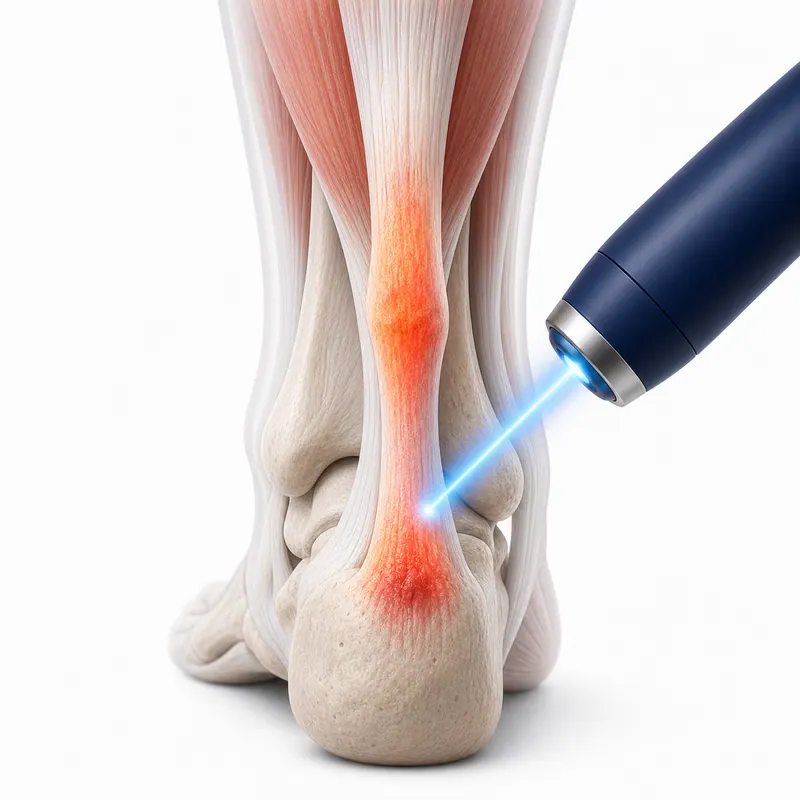
The Adelaide Cold Laser connection: At Adelaide Cold Laser, Dr Sam Johnson (Chiropractor) uses a multi-wavelength clinical-grade device to deliver photobiomodulation directly to the Achilles tendon. Research suggests this may help reduce pain when used alongside a tailored exercise programme — potentially allowing you to return to activity sooner than with exercise alone. Individual responses vary.
A proper assessment: Before any treatment, Dr Sam conducts a thorough assessment of your Achilles tendon, ankle mechanics, training history, and any contributing factors. This helps determine whether photobiomodulation is appropriate for your situation and what a realistic management plan looks like.
🏀 The Weekend Warrior
What you might be feeling:
- A sharp pinch in your Achilles during a weekend game of tennis, basketball, or football
- Swelling and tenderness that lingers for days after activity
- The sense that your body is not recovering the way it used to
- Reluctance to give up the sports that keep you sane during a busy work week
You sit at a desk five days a week, then push hard on the weekend. Your Achilles has been grumbling for a while — you just kept playing through it. Now it is getting harder to ignore. Your GP suggested rest and anti-inflammatories, maybe a physio referral. But you have been down that road before, and the idea of months of exercises with no guarantee is discouraging.
The Adelaide Cold Laser connection: A double-blind RCT found that combining photobiomodulation with a reduced exercise schedule (twice weekly instead of twice daily) produced significantly better Achilles function scores than more intensive exercise alone. This may be relevant if compliance with a demanding daily programme is a barrier for you. Individual responses vary.
A proper assessment: Your assessment considers not just the tendon itself but the pattern of loading that may be driving it — the “boom and bust” cycle of sedentary weeks punctuated by intense weekend activity.
🧍 The Active Professional on Their Feet
What you might be feeling:
- A burning ache in the back of your ankle by mid-afternoon, worse by shift end
- Morning stiffness in your Achilles that takes several minutes of walking to ease
- Pain when climbing stairs or walking uphill
- Concern that you cannot afford to take time off work for a long rehabilitation programme
If your job keeps you on your feet all day — nursing, teaching, hospitality, retail, trades — your Achilles never gets a proper rest. You cannot simply “stop the aggravating activity” when the activity is your livelihood. Anti-inflammatories take the edge off but you are uncomfortable relying on them long-term, and you have read they may actually impair tendon healing.
The Adelaide Cold Laser connection: Photobiomodulation sessions are brief (typically 5–10 minutes for the treatment itself) and non-invasive. Adelaide Cold Laser is open Monday to Friday 7am–7pm, Saturday 8am–12pm, directly on Marion Road — designed around working schedules. Individual responses vary.
A proper assessment: Dr Sam assesses your tendon health in the context of your occupational demands, footwear, and daily loading patterns to build a management plan that works around your life, not against it.
🚶 The Over-40 Active Adult
What you might be feeling:
- Achilles pain that appeared gradually over weeks or months with no obvious injury
- Thickening or a noticeable bump on the tendon
- Stiffness and pain that worsens after periods of sitting, then eases with gentle movement
- Worry that age-related changes mean this will never fully resolve
Achilles tendinopathy peaks in the 30–50 age group, and risk increases further beyond 45. The tendon’s capacity to repair slows with age, and decades of accumulated loading take their toll. You may have been told to “just rest it,” but tendons do not respond well to complete rest — they need the right kind of load, delivered at the right intensity.
The Adelaide Cold Laser connection: Animal research has identified mechanisms by which photobiomodulation may support tendon tissue at a cellular level — including collagen organisation and inflammatory modulation — though human evidence for these mechanisms remains limited. Used alongside an appropriate exercise programme, PBM may form part of a broader management approach. Individual responses vary.
A proper assessment: Your assessment includes a full history of the condition’s progression, previous treatments tried, and any relevant health factors (such as diabetes or medication use) that may influence tendon healing.
How Photobiomodulation May Help Achilles Tendinopathy
The proposed mechanism centres on photon absorption by cytochrome c oxidase, a key enzyme in the mitochondrial electron transport chain. When light at therapeutic wavelengths reaches the tendon, it may trigger a cascade of cellular responses including increased ATP production (cellular energy), release of nitric oxide (which supports local blood flow), and modulation of inflammatory signalling pathways.
For tendons specifically, a systematic review of 55 studies (He et al. 2023) identified several ways PBM may support healing in animal models: stimulating collagen formation and organisation, promoting growth factor production (including VEGF and TGF-beta1), and reducing inflammatory mediators such as COX-2, PGE2, and pro-inflammatory cytokines. However, in human studies, only anti-inflammatory effects (reduced PGE2 in peritendinous tissue) have been confirmed.
What the research suggests may occur
- Pain modulation — One RCT found significantly lower pain scores at 4, 8, and 12 weeks when PBM was added to eccentric exercise, with the treatment group reaching pain milestones approximately 8 weeks ahead of controls (Stergioulas et al. 2008)
- Inflammatory response — Animal studies consistently show PBM may reduce inflammatory markers (IL-1beta, IL-6, TNF-alpha, COX-2, PGE2) in tendon tissue, though human confirmation is limited to PGE2 reduction (He et al. 2023)
- Cellular metabolism — Laboratory research suggests PBM may stimulate tenocyte proliferation, increase ATP production, and promote collagen synthesis via signalling pathways including ERK and TGF-beta1 (Chen et al. 2014)
- Functional outcomes — A 4-arm RCT found that PBM combined with a reduced exercise schedule produced significantly better VISA-A function scores than exercise alone, though other trials have not replicated this finding (Tumilty et al. 2016)
It is important to note that the overall evidence remains mixed. Two RCTs and one systematic review found no significant advantage for PBM over placebo when added to exercise. The strongest positive results emerged when treatment parameters followed World Association for Laser Therapy (WALT) recommended dosimetry — suggesting that how PBM is delivered matters as much as whether it is used.
Individual responses to photobiomodulation vary. This information is not intended as medical advice. Consult your healthcare provider to determine whether PBM may be appropriate for your situation.
Ready to explore cold laser therapy?
$99 initial consultation includes full assessment and first treatment session. No lock-in plans.
What the Evidence Says
Peer-reviewed studies examining photobiomodulation for Achilles tendinopathy
Stergioulas et al. (2008) — American Journal of Sports Medicine
Randomised controlled trial (Level 1 evidence)
Fifty-two recreational athletes with chronic Achilles tendinopathy (symptoms lasting more than 3 months) were randomised to receive either photobiomodulation or placebo, both combined with an eccentric exercise programme. The study used 820nm laser at 60 mW/cm² across 6 points along the tendon, delivering 5.4 J per session over 12 sessions.
The PBM group showed significantly lower pain scores at all measured time points: 53.6mm versus 71.5mm at 4 weeks (p=0.0003), 37.3mm versus 62.8mm at 8 weeks (p=0.0002), and 33.0mm versus 53.0mm at 12 weeks (p=0.007) on a 100mm visual analogue scale. The PBM group at 4 weeks had already reached pain levels that the placebo group did not achieve until week 12.
Secondary outcomes including morning stiffness, dorsiflexion range of motion, and palpation tenderness all favoured the PBM group. Dosimetry parameters aligned with WALT recommendations.
Individual responses to photobiomodulation vary. A single study, while promising, does not constitute definitive evidence.
PMID: 18272794
Tumilty et al. (2016) — Lasers in Medical Science
Double-blind randomised controlled trial (4-arm design)
Eighty participants with chronic Achilles tendinopathy were randomised across four groups: placebo with daily exercise, PBM with daily exercise, placebo with twice-weekly exercise, and PBM with twice-weekly exercise. This design allowed researchers to isolate the effects of both PBM and exercise frequency.
At 12 weeks, the group receiving PBM plus twice-weekly exercise achieved significantly greater improvements in VISA-A scores (the standard Achilles function measure) than all other groups — outperforming placebo with daily exercise by 18.5 points, PBM with daily exercise by 10.4 points, and placebo with twice-weekly exercise by 11.3 points.
This suggests that PBM may allow comparable or better outcomes with a substantially less demanding exercise schedule — a finding relevant to patients who struggle with the compliance burden of traditional twice-daily eccentric loading programmes.
Individual responses vary. These results may not apply to all presentations of Achilles tendinopathy.
PMID: 26610637
Leal-Junior et al. (2025) — Photodiagnosis and Photodynamic Therapy
Comparative device study on human volunteers
This 2025 study compared three different photobiomodulation devices applied to human Achilles tendons: a high-powered single-wavelength device (9,000 mW), a low-powered single-wavelength device (100 mW), and a low-powered multi-wavelength device (450 mW).
The multi-wavelength device delivered 141.1 microWatts of transmitted power through the tendon — 3.5 times more than the high-powered single-wavelength device (39.7 microWatts) and nearly 6 times more than the low-powered single-wavelength device (23.9 microWatts). The multi-wavelength device also produced the least thermal discomfort.
The clinical-grade super-pulsed laser device used at Adelaide Cold Laser is a multi-wavelength device combining 905nm super-pulsed laser with 875nm infrared and 640nm red LEDs — a configuration consistent with the design principles validated in this study.
Device comparison data does not equate to clinical efficacy. Individual treatment responses vary.
PMID: 41015277
“The PBM group at 4 weeks had reached pain levels equivalent to the placebo group at 12 weeks — suggesting an approximate 8-week acceleration in pain relief when photobiomodulation was added to eccentric exercise.”
— Stergioulas et al. (2008), American Journal of Sports Medicine, 36(5):881-887
Individual responses vary. This finding is from a single RCT and may not apply to all patients.
What to Expect — Treatment Walkthrough
Your first visit ($99)
- Assessment — Dr Sam Johnson (Chiropractor) conducts a thorough assessment of your Achilles tendon, including a history of your symptoms, previous treatments, activity levels, and any contributing factors. He examines the tendon directly, assesses ankle range of motion, and evaluates biomechanical factors that may be contributing to the problem. This helps determine whether photobiomodulation is appropriate for your presentation.
- Treatment parameters — Based on the assessment findings, Dr Sam selects the appropriate treatment settings on the clinical-grade super-pulsed laser device. The device delivers multiple wavelengths simultaneously: 905nm super-pulsed laser for deeper penetration, 875nm infrared LEDs, and 640nm red LEDs. Treatment parameters are guided by World Association for Laser Therapy (WALT) recommendations and the dosimetry used in positive clinical trials.
- The treatment — The device is applied directly to the skin over the Achilles tendon. You will feel the treatment head resting on your skin but the light itself is not felt — there is no heat, no pain, and no sensation during treatment. A typical session treats multiple points along the tendon and takes approximately 5–10 minutes. Research suggests treating the tendon in a relaxed position (knee slightly bent, foot gently pointed) may optimise light penetration.
- Your plan — Dr Sam discusses what a realistic management plan looks like for your situation, including the role of exercise, activity modification, and how PBM fits alongside these. Clinical trials typically used 8–12 sessions over 4–8 weeks. There are no lock-in plans. The decision about how to proceed is always yours.
Ongoing care
Follow-up sessions are shorter, typically 15–20 minutes including a brief progress check and the PBM treatment itself. Dr Sam monitors your response and adjusts the approach as needed. If PBM does not appear to be contributing to your progress, he will tell you.
Individual responses to photobiomodulation vary. Treatment outcomes cannot be predicted or guaranteed.
Red Flags — When to See Your GP Urgently
If you experience any of the following, seek medical attention promptly. These symptoms may indicate a condition requiring urgent assessment:
- A sudden “pop” or snapping sensation in the back of your ankle, especially during activity
- Sudden inability to push off on the affected foot or walk normally
- Significant sudden swelling or bruising around the Achilles tendon area
- Pain, redness, warmth, or swelling in the calf (may indicate a blood clot — seek immediate medical attention)
- Achilles symptoms that develop shortly after starting a fluoroquinolone antibiotic (e.g. ciprofloxacin)
- Fever combined with tendon pain and swelling (may indicate infection)
This is not a comprehensive diagnostic list. If you are unsure whether your symptoms require urgent attention, contact your GP or call 13 HEALTH (13 43 25 84).
Frequently Asked Questions
I’ve been told to do 180 heel drops a day for 12 weeks. Is there an easier way?
Can I still run while having cold laser treatment?
I’ve had this for months. Is it too late for cold laser to help?
My Achilles is fine once I warm up. Do I really need treatment?
What does cold laser treatment cost?
How are cold laser appointments billed?
Do I need a GP referral for cold laser treatment?
I’ve tried everything else. Why would this be any different?
What does the research actually say about cold laser for Achilles tendinopathy?
Is cold laser therapy safe for Achilles tendons?
What device do you use?
Why do some studies show cold laser works and others don’t?
What is the difference between Achilles tendinopathy and Achilles tendinitis?
Is my Achilles tendinopathy at the midportion or insertion?
Could my Achilles tendon rupture?
Questions? We’re here to help.
Call us on (08) 8297 5277 or book online — no obligation.
Ready to Explore Whether Cold Laser May Help Your Achilles?
Your first consultation is $99 and includes a full assessment plus your initial treatment. No lock-in plans. The decision is always yours.
References
- Martimbianco ALC et al. (2020). Photobiomodulation with low-level laser therapy for treating Achilles tendinopathy. Clinical Rehabilitation, 34(6):713-722. PMID: 32204620
- He K et al. (2023). Effects of LLLT on Tendon Healing. Annals of Biomedical Engineering, 51(12):2659-2707. PMID: 37899380
- Tumilty S et al. (2010). LLLT for tendinopathy: systematic review. Photomedicine and Laser Surgery, 28(1):3-16. PMID: 19708800
- Stergioulas A et al. (2008). LLLT and eccentric exercises in chronic Achilles tendinopathy. American Journal of Sports Medicine, 36(5):881-887. PMID: 18272794
- Tumilty S et al. (2012). LLLT as adjunct to eccentric exercise. Archives of Physical Medicine and Rehabilitation, 93(5):733-739. PMID: 22541305
- Tumilty S et al. (2016). Photobiomodulation and eccentric exercise for Achilles tendinopathy. Lasers in Medical Science, 31(1):127-135. PMID: 26610637
- Shriya N et al. (2024). LLLT Combined With Eccentric Exercise. Cureus, 16(6):e62919. PMID: 39040733
- Tenforde AS et al. (2025). Exercise, radial pressure waves, and PBM. BMJ Open Sport & Exercise Medicine, 11(4):e002442. PMID: 41070206
- Leal-Junior ECP et al. (2025). Multi-wavelength PBM device comparison. Photodiagnosis and Photodynamic Therapy, 56:105234. PMID: 41015277
- Bordvik DH et al. (2017). Penetration of 904nm and 810nm laser. Photomedicine and Laser Surgery, 35(7):371-376. PMID: 28436746
- Chen H et al. (2014). 904nm GaAs laser stimulation of tenocytes. Lasers in Medical Science, 30(3):1081-1087. PMID: 25231827
- Corrigan P et al. (2019). Immediate effect of PBM on Achilles tendon. Translational Sports Medicine, 2(4):164-172. PMID: 31742249
- de Oliveira AR et al. (2022). PBM with conservative treatment for Achilles rupture. Archives of Rehabilitation Research, 4(4):100219. PMID: 36545533
- Knapik JJ, Pope R (2020). Achilles tendinopathy review. Journal of Special Operations Medicine, 20(1):125-140. PMID: 32203618
Entity Summary
Practitioner: Dr Sam Johnson (Chiropractor), BSc(Chiro) MChiro — Macquarie University
Practice: Adelaide Cold Laser
Address: 528 Marion Road, Plympton Park SA 5038
Phone: (08) 8297 5277
Hours: Mon–Fri 7am–7pm, Sat 8am–12pm
Device: clinical-grade super-pulsed laser device — super-pulsed laser, multiple wavelengths (905nm super-pulsed, 875nm infrared, 640nm red)
Clinical review date: 28 April 2026
This page provides general information about photobiomodulation (cold laser therapy) and Achilles tendinopathy based on published clinical research. It is not intended as medical advice and should not replace consultation with a qualified healthcare provider. Individual responses to photobiomodulation therapy vary. The evidence for PBM as a treatment for Achilles tendinopathy is currently rated as low-to-moderate certainty. Treatment outcomes cannot be predicted or guaranteed. Dr Sam Johnson is a registered chiropractor (AHPRA). Adelaide Cold Laser uses a clinical-grade device. All clinical statements on this page are based on peer-reviewed published research and are hedged accordingly. References with PubMed identifiers are provided for verification. No lock-in plans. The decision is always yours.
Related Conditions
- Cold Laser for Plantar Fasciitis — The plantar fascia and Achilles tendon are mechanically connected; conditions in one frequently affect the other
- Cold Laser for Knee Osteoarthritis — Altered gait from Achilles pain may contribute to increased knee loading
- Cold Laser for Frozen Shoulder — Another condition where PBM research shows promise as an adjunct to exercise
- What Is Cold Laser Therapy? — General overview of photobiomodulation for patients new to cold laser