Cold Laser Therapy for Tennis Elbow
Backed by 7 systematic reviews and 11 randomised controlled trials — research suggests photobiomodulation may help reduce elbow pain and improve grip strength without injections or medication
Who gets tennis elbow?
Tap to see how your situation connects to the research
🖥️ Office and Desk Workers
What you might be feeling:
- A dull ache on the outside of your elbow that sharpens when you grip your mouse
- Pain when lifting your coffee cup or turning a door handle
- Forearm tightness that builds through the afternoon
- Difficulty carrying your laptop bag on the affected side
You spend your days at a keyboard, clicking and scrolling through documents. At first the twinge was only at the end of a long day. Now it greets you before your first morning meeting and lingers through dinner.
Computer mouse use — not typing — is the primary desk-worker trigger for lateral epicondylitis. Repetitive clicking and gripping keeps the common extensor tendon under sustained low-grade load, and your dominant hand (usually your mouse hand) bears the brunt.
The Adelaide Cold Laser connection: Research suggests that photobiomodulation at specific wavelengths may help support tendon recovery and reduce pain by promoting cellular energy production in the affected tissue. Our clinical-grade super-pulsed laser device delivers 905nm super-pulsed laser, which aligns with the wavelength subgroup that showed the strongest positive outcomes in a meta-analysis of 730 patients (Bjordal 2008). Individual responses vary.
A proper assessment first: Dr Sam Johnson (Chiropractor) will assess your elbow, forearm, wrist and shoulder to identify what is driving your pain. Not every elbow ache is tennis elbow, and an accurate clinical picture guides whether photobiomodulation, manual therapy, ergonomic adjustments, or a combination approach may be appropriate for you.
🔧 Tradies and Manual Workers
What you might be feeling:
- Sharp pain when gripping a drill, hammer, or wrench
- Weakness when lifting materials or turning bolts
- Elbow pain that worsens as the work week goes on
- Trouble shaking hands without wincing
Your livelihood depends on your grip. Plumbing, carpentry, electrical work, manufacturing — they all load the same forearm tendons in the same repetitive patterns. Unlike a desk worker who can switch to a trackpad, you cannot simply avoid the movements causing the problem.
Australian GP data shows that tennis elbow is 10 times more likely to be work-related than other conditions managed in general practice. Trades involving forceful gripping and repetitive forearm rotation carry the highest risk. Manual work is also a factor in slower recovery, making effective management especially important.
The Adelaide Cold Laser connection: Photobiomodulation is non-invasive and requires no medication — you do not need to take time off work for treatment. Sessions typically run 10-15 minutes. Research suggests it may support the tendon repair process at a cellular level. Individual responses vary.
A proper assessment first: We will look at your grip mechanics, wrist position, and the specific demands of your work. Understanding how your elbow is being loaded helps guide a practical management approach — one that accounts for the fact that you cannot simply rest for six weeks.
🏋️ Gym and Fitness Enthusiasts
What you might be feeling:
- Pain during pulling movements — chin-ups, rows, deadlifts
- A burning sensation on the outside of your elbow during bicep curls
- Reduced grip strength that limits your training weights
- Frustration at having to modify or skip exercises
You are fit, active, and used to working through discomfort. But this is different. The pain on the outside of your elbow does not respond to warming up, and pushing through it only makes the next session worse.
Repetitive gripping under load — barbells, dumbbells, pull-up bars — places significant strain on the common extensor origin at the lateral epicondyle. The tendons that extend your wrist are the same ones working overtime every time you close your hand around a bar.
The Adelaide Cold Laser connection: A 2007 RCT found that 904nm laser combined with exercise produced significantly greater improvements in grip strength and pain compared to exercise alone (Stergioulas 2007). Our 905nm super-pulsed laser aligns with this wavelength. Research suggests photobiomodulation may complement your rehabilitation exercises rather than replace them. Individual responses vary.
A proper assessment first: We will assess your elbow in the context of your training — which movements aggravate it, your grip patterns, and whether contributing factors in your shoulder or wrist need attention. The goal is to get you back to training, not to tell you to stop.
🎾 Weekend Sport Players
What you might be feeling:
- Pain during your backhand or golf downswing
- Difficulty gripping your racquet, club, or cricket bat comfortably
- Elbow stiffness the morning after a game
- A reluctance to play because you know it will flare up
Here is an irony worth knowing: only about 10% of people diagnosed with “tennis elbow” actually play tennis. The name stuck, but the condition is overwhelmingly caused by everyday repetitive movements rather than sport. That said, racquet sports, golf, and cricket batting do place genuine load on the lateral epicondyle tendons — particularly with repeated wrist extension and grip.
The Adelaide Cold Laser connection: A large multicentre study of 324 patients using a combination of wavelengths including 904nm reported pain relief in 82% of acute cases and 66% of chronic cases (Simunovic 1998). Our clinical device delivers a similar multi-wavelength combination. Individual responses vary, and results from clinical studies may not predict your personal outcome.
A proper assessment first: We will examine your elbow alongside your sport-specific movement patterns. Grip size, technique modifications, and a structured return to sport all factor into a sensible plan.
How Photobiomodulation May Help Tennis Elbow
How it works at a cellular level
Light at wavelengths between 600-1000nm is absorbed by cytochrome c oxidase, an enzyme in the mitochondria (the energy-producing structures within your cells). This absorption may trigger a cascade of cellular events:
- Increased cellular energy production — cytochrome c oxidase activation may promote ATP (adenosine triphosphate) production, providing cells with the energy needed for repair processes
- Collagen synthesis support — research suggests photobiomodulation may increase fibroblast activity and promote organised collagen production, which is relevant because disorganised collagen is a hallmark of tendinosis
- Inflammatory modulation — a 2025 multicentre trial found that photobiomodulation was associated with significant reduction in TNF-alpha, a key inflammatory marker (de Oliveira 2025, PMID 41047274)
- Microcirculation improvement — the tendon insertion zone at the lateral epicondyle has limited blood supply; research suggests photobiomodulation may help promote new blood vessel formation in the repair area
What research suggests may occur
- Pain reduction when gripping and during resisted wrist extension
- Improved grip strength over the treatment plan
- Reduced tenderness at the lateral epicondyle
- Benefits that may continue to develop for weeks after the treatment plan ends
Important limitations
Not everyone responds to photobiomodulation, and the research clearly shows that dosage, wavelength, and treatment location all matter. Studies using incorrect wavelengths (820nm, 830nm, 1064nm) or targeting acupuncture points rather than the tendon insertion showed no benefit (Bjordal 2008). The strongest evidence supports 904nm wavelength applied directly to the lateral epicondyle tendon insertions — which is the approach used at Adelaide Cold Laser.
Individual responses to photobiomodulation therapy vary. The information on this page describes findings from published research and should not be interpreted as a guarantee of any particular outcome. Dr Sam Johnson (Chiropractor) will discuss whether this approach may be appropriate for your situation during your initial assessment.
Ready to explore cold laser therapy?
$99 initial consultation includes full assessment and first treatment session. No lock-in plans.
The Evidence Base
7 systematic reviews, 11 RCTs, 1,200+ participants
Bjordal et al. 2008 — Landmark Meta-Analysis (730 patients)
A meta-analysis of 13 placebo-controlled randomised trials found that low-level laser therapy at 904nm wavelength, applied directly to the lateral elbow tendon insertions, was associated with clinically meaningful pain relief (17.2mm reduction on a 100mm scale). The 904nm subgroup also showed significantly improved global outcomes (RR 1.53). Trials using other wavelengths or targeting acupuncture points showed no benefit — confirming that wavelength and treatment location are critical.
This is a summary of published research findings. Individual treatment outcomes vary and are not guaranteed.
PMID: 18510742 • DOI: 10.1186/1471-2474-9-75
de Oliveira et al. 2025 — Multicentre Triple-Blinded RCT (Multi Radiance device)
This 2025 trial used a clinical super-pulsed laser device of the same class used at Adelaide Cold Laser. Participants receiving active photobiomodulation had a 72% responder rate (30% or greater pain reduction) compared with 40% in the placebo group (P=0.045). The treatment group also showed significantly reduced TNF-alpha, a key inflammatory marker, at both post-treatment and follow-up time points (P<0.0001).
Individual responses vary. This study’s results may not predict your personal outcome.
PMID: 41047274 • DOI: 10.1136/bmjopen-2024-104789
Zhang et al. 2025 — Most Recent Meta-Analysis (12 RCTs)
The most recent meta-analysis confirmed that low-level laser therapy significantly reduces pain compared to both baseline and placebo (P<0.00001). Both LLLT and high-intensity laser improved grip strength, but LLLT demonstrated more consistent significance in pain relief specifically. The review also found that laser combined with bracing produced synergistic effects — greater pain relief and functional improvement than either alone.
Research findings reflect group averages from controlled studies. Individual responses to treatment vary.
“91% of tendinopathy trials using WALT-recommended dosages reported positive effects.”
Tumilty et al. 2010, Photomedicine and Laser Surgery (PMID 19708800)
This finding highlights why dosage precision matters. Our clinical device delivers wavelengths and energy densities within ranges referenced by the World Association for Laser Therapy. Individual responses vary.
What to Expect
Your first visit ($99)
- Clinical assessment — Dr Sam Johnson (Chiropractor) will take a detailed history of your elbow pain, including when it started, what aggravates it, what you have already tried, and how it affects your work and daily activities. He will perform specific orthopaedic tests to confirm the diagnosis and rule out other causes of elbow pain.
- Treatment planning — If photobiomodulation appears appropriate for your situation, Sam will explain the approach, expected treatment frequency, and what the research suggests for your type of presentation. You will have the opportunity to ask questions and decide whether you would like to proceed. No lock-in plans. The decision is always yours.
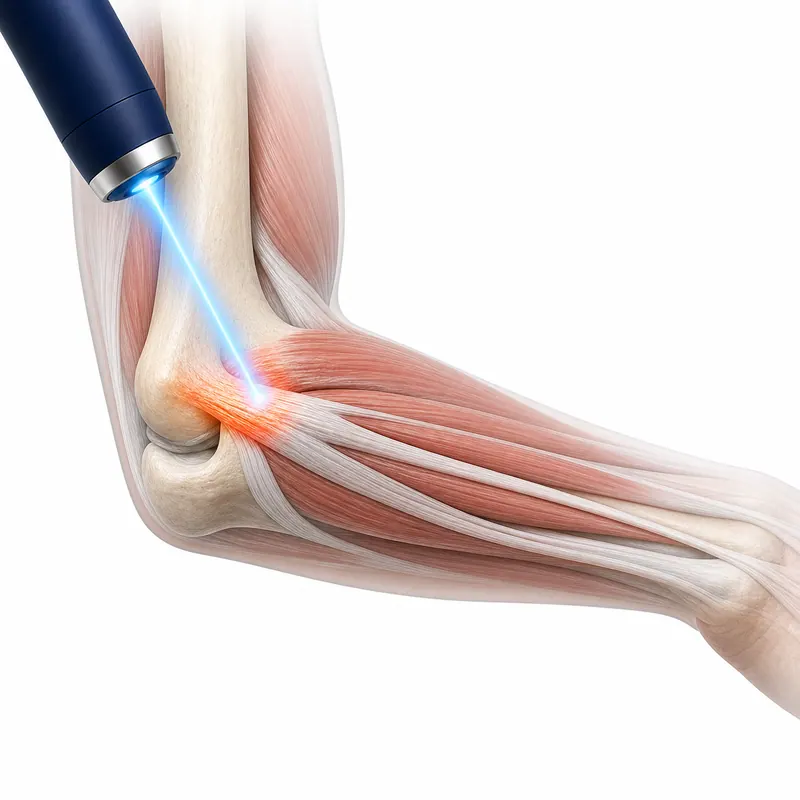
- First treatment session — The clinical device is applied directly to the lateral epicondyle tendon insertion — the specific treatment location supported by the strongest research evidence. The treatment is non-invasive. Most people feel gentle warmth or nothing at all.
- Home guidance — You will receive practical advice on load management, ergonomic modifications (particularly for mouse use or manual work), and any exercises that may complement your treatment.
Ongoing care
- Treatment sessions are typically 10-15 minutes including setup
- Research protocols showing positive outcomes used 2-3 sessions per week
- A typical course is 6-12 sessions over 3-6 weeks, depending on your response
- Benefits may continue to develop for 8-12 weeks after the treatment plan concludes (Emanet 2010)
- On the Marion Road commuter corridor — convenient before or after work from Plympton Park, Plympton, Park Holme, Glenelg North, Morphettville, Edwardstown, Ascot Park, and Marion
Treatment frequency and duration are individualised based on your clinical presentation and response. The figures above reflect protocols used in published research studies.
⚠️ When to See Your GP Urgently
While tennis elbow is common and generally responds to conservative management, certain symptoms warrant prompt medical attention:
- Sudden elbow swelling with redness and warmth — may indicate infection or inflammatory arthritis requiring urgent assessment
- Elbow pain after a fall or direct impact — could indicate a fracture, particularly if you cannot straighten or bend the arm fully
- Numbness or tingling radiating into your ring and little fingers — may suggest ulnar nerve involvement requiring different management
- Elbow that locks, catches, or gives way — may indicate a loose body or ligament injury within the joint
- Rapidly worsening weakness in your hand or forearm — progressive nerve compression needs timely investigation
- Unexplained weight loss, night pain, or fatigue alongside elbow symptoms — while rare, these require investigation to rule out other conditions
If you are unsure whether your symptoms are urgent, please contact your GP or call 13 HEALTH (13 43 25 84) for advice.
Frequently Asked Questions
I sit at a desk all day — is that really what caused my tennis elbow?
It might be. Computer mouse use is the primary desk-worker trigger for lateral epicondylitis — not typing, surprisingly. Repetitive clicking, scrolling, and gripping your mouse keeps the common extensor tendon under sustained load. If your dominant hand is your mouse hand, you are loading the same tendons that are causing your pain for hours every day. Simple changes like mouse positioning, a vertical mouse, or alternating hands may help reduce ongoing strain. Individual circumstances vary.
Do I need to stop playing tennis (or golf, or going to the gym) while getting treatment?
Not necessarily. Dr Sam Johnson (Chiropractor) will assess your specific situation and help you modify activities rather than eliminate them entirely. Research suggests that photobiomodulation combined with appropriate exercise may produce better outcomes than rest alone (Stergioulas 2007). The goal is smart load management — keeping you active while allowing recovery.
Will I need to take time off work?
No. Photobiomodulation is non-invasive with no medication. You can return to normal activities immediately after each session. Sessions are typically 10-15 minutes, so they fit easily into a lunch break or before/after work. We are on Marion Road — convenient if you commute through Plympton Park, Park Holme, or surrounding suburbs.
Why is it called tennis elbow if only 10% of cases involve tennis?
Good question. The name dates back to 1883 and stuck in everyday language, but the condition is overwhelmingly caused by repetitive work-related movements — gripping, twisting, lifting. Trades workers, office workers using a mouse, and manual labourers are far more commonly affected than racquet sport players. The clinical name, lateral epicondylitis (or more accurately lateral epicondylopathy), describes the anatomy rather than the cause.
How much does cold laser treatment for tennis elbow cost?
Your initial consultation is $99, which includes a full clinical assessment and your first treatment session. Ongoing care options are discussed at your first visit. There are no lock-in plans and no ongoing contracts. You pay per visit, and the decision to continue is always yours.
Is cold laser covered by health insurance?
Treatment provided by Dr Sam Johnson (Chiropractor) is private pay. We do not process health fund claims for cold laser services. Check with your insurer regarding your individual rebate entitlements.
Do I need a GP referral for cold laser treatment?
No. You do not need a referral from a GP to see Dr Sam Johnson (Chiropractor). You can book directly. However, if you have been referred by your GP, please bring any relevant imaging or correspondence to your first appointment.
Why would I try cold laser instead of just getting a cortisone injection?
This is worth understanding. Two landmark Australian RCTs (conducted in Brisbane) found that while corticosteroid injections provide fast relief in the first six weeks, they were associated with significantly worse outcomes at 12 months compared to both physiotherapy and even doing nothing. One trial found a 54% recurrence rate with corticosteroid injection versus 12% with placebo injection at one year (Coombes 2013). Photobiomodulation is non-invasive, carries no injection-related risks, and research suggests its benefits may be more sustained. Your GP can discuss whether an injection is appropriate for your situation — we are simply noting what the Australian research has found.
What evidence supports cold laser for tennis elbow?
Tennis elbow is one of the most thoroughly studied conditions for photobiomodulation. There are 7 systematic reviews or meta-analyses and 11 randomised controlled trials involving over 1,200 participants. The landmark Bjordal 2008 meta-analysis of 730 patients found clinically meaningful pain relief when 904nm wavelength was used and applied directly to the tendon insertion. A 2025 multicentre trial using a a clinical super-pulsed laser device of the same class as ours found a 72% responder rate compared to 40% with placebo. Outcomes vary between individuals.
Is cold laser treatment safe? Are there any side effects?
No serious adverse events have been reported in any of the published clinical trials on photobiomodulation for tennis elbow. It delivers super-pulsed laser, meaning energy is delivered in billionth-of-a-second pulses rather than continuous beams — non-thermal energy delivery. Most people feel nothing or a mild warmth during the session.
What device do you use and is it registered?
We use a clinical-grade super-pulsed laser device. It delivers four wavelengths simultaneously: 905nm super-pulsed laser, 875nm infrared LEDs, 660nm red light, and 465nm blue light, combined with a static magnetic field. The 905nm and 660nm wavelengths align directly with the two wavelength subgroups that showed the strongest positive evidence in the Bjordal 2008 meta-analysis (904nm and 632nm).
How does our laser compare to other devices?
Not all laser devices are the same, and research consistently shows that wavelength, dosage, and treatment location determine outcomes. Our 905nm super-pulsed laser is within the wavelength range that produced positive evidence in published systematic reviews. Its multi-wavelength approach covers both the 904nm and 632nm positive subgroups identified by Bjordal (2008). We follow World Association for Laser Therapy (WALT) dosage guidelines, which 91% of positive tendinopathy trials also used (Tumilty 2010).
How long does tennis elbow take to recover, with or without treatment?
Without treatment, tennis elbow typically resolves in 12-18 months in most cases, though prolonged disability during that period is common. With photobiomodulation, research protocols showing positive outcomes ran for 3-6 weeks (6-12 sessions). Importantly, benefits may continue to develop for 8-12 weeks after the treatment plan concludes — a 2010 RCT found that the laser group’s advantage over placebo only became statistically significant at the 12-week follow-up (Emanet 2010). Recovery timelines vary between individuals.
My tennis elbow keeps coming back. Can cold laser help with recurrence?
Recurrence is a genuine concern. Australian research found a 54% recurrence rate with corticosteroid injections at one year (Coombes 2013), compared to the general recurrence rate of about 8.5% within two years (Sanders 2015). While no treatment can guarantee prevention of recurrence, photobiomodulation combined with appropriate exercise may address underlying tendon changes rather than simply masking pain. We also focus on identifying and modifying the aggravating factors — whether that is mouse ergonomics, grip technique, or work patterns.
Is my tennis elbow actually tendinitis or tendinosis — and does it matter for treatment?
It matters more than most people realise. Most chronic cases of tennis elbow involve tendinosis (degeneration and disorganised collagen) rather than tendinitis (active inflammation). This distinction is clinically relevant because anti-inflammatory approaches like cortisone are targeting inflammation that may no longer be the primary problem. Research suggests photobiomodulation may support organised collagen production and fibroblast maturation — addressing the degenerative changes that characterise tendinosis rather than simply suppressing inflammation.
Other Conditions We May Help With
Questions? We’re here to help.
Call us on (08) 8297 5277 or book online — no obligation.
Book a Consultation
$99 initial consultation includes full clinical assessment and first treatment session.
No lock-in plans. The decision is always yours.
(08) 8297 5277 • 528 Marion Road, Plympton Park SA 5038
Mon-Fri 7am-7pm • Sat 8am-12pm
References
- Zhang et al. (2025). High-intensity versus low-level laser therapy in tennis elbow: systematic review and meta-analysis of 12 RCTs. American Journal of Physical Medicine & Rehabilitation, 105(2):134-142. PMID: 40856482
- Bjordal et al. (2008). A systematic review with procedural assessments and meta-analysis of low level laser therapy in lateral elbow tendinopathy. BMC Musculoskeletal Disorders, 9:75. PMID: 18510742
- de Oliveira et al. (2025). PBMT-sMF in lateral epicondylitis: multicentre, triple-blinded, placebo-controlled RCT. BMJ Open, 15(10):e104789. PMID: 41047274
- Saleh et al. (2024). High-intensity versus low-level laser in musculoskeletal disorders: systematic review. Lasers in Medical Science, 39(1):179. PMID: 38990213
- Tumilty et al. (2010). Low level laser treatment of tendinopathy: a systematic review with meta-analysis. Photomedicine and Laser Surgery, 28(1):3-16. PMID: 19708800
- Mamais et al. (2020). Effectiveness of low level laser therapy in lateral epicondylitis: umbrella review of 7 SRs/MAs. Laser Therapy, 27(3):174-186. PMID: 32158063
- Stergioulas (2007). Low-level laser treatment combined with plyometric exercises in tennis elbow. Photomedicine and Laser Surgery, 25(3):205-13. PMID: 17603862
- Lam & Cheing (2007). Effects of 904nm LLLT in treatment of lateral epicondylitis: a randomised controlled trial. Photomedicine and Laser Surgery, 25(2):65-71. PMID: 17508839
- Emanet et al. (2010). GaAs laser therapy using WALT-recommended doses in lateral epicondylitis. Photomedicine and Laser Surgery, 28(3):397-403. PMID: 19877824
- Celik & Kulunkoglu (2019). Photobiomodulation therapy versus extracorporeal shock wave therapy in lateral epicondylitis. Photobiomodulation, Photomedicine, and Laser Surgery, 37(5):269-275. PMID: 31084562
- Coombes et al. (2013). Effect of corticosteroid injection, physiotherapy, or both on clinical outcomes in patients with lateral epicondylitis. JAMA, 309(5):461-9. PMID: 23385272
- Bisset et al. (2006). Mobilisation with movement and exercise, corticosteroid injection, or wait and see for tennis elbow. BMJ, 333(7575):939. PMID: 17012266
- Lyu et al. (2022). The functions and mechanisms of low-level laser therapy in tendon repair (review). Frontiers in Physiology. PMID: 35242050
- Sanders et al. (2015). Incidence and recurrence of lateral epicondylitis in general practice. Journal of Hand Therapy. PMID: 25656546
- Bretschneider et al. (2021). Occupational risk factors for lateral epicondylitis: systematic review. International Archives of Occupational and Environmental Health. PMID: 34674287
- Vicenzino et al. (2017). Has the management of lateral epicondylitis in general practice changed in the past 15 years? Australian BEACH study. British Journal of Sports Medicine. PMID: 28727755
About Adelaide Cold Laser
Practitioner: Dr Sam Johnson (Chiropractor), BSc(Chiro), MChiro — Macquarie University
Practice: Adelaide Cold Laser • 528 Marion Road, Plympton Park SA 5038
Phone: (08) 8297 5277 • Email: wecanhelp@stapletonchiropractic.com.au
Hours: Monday to Friday 7:00am – 7:00pm • Saturday 8:00am – 12:00pm
Pricing: $99 initial consultation • Private pay only • No referral required
The information on this page is provided for general educational purposes and is not intended as medical advice. It describes findings from published peer-reviewed research and should not be interpreted as a guarantee or promise of any particular treatment outcome. Individual responses to photobiomodulation therapy vary. Not all patients will experience the results described in published studies.
Dr Sam Johnson (Chiropractor) will conduct a thorough clinical assessment before recommending any treatment approach. If you are experiencing elbow pain, please consult a qualified healthcare practitioner for personalised advice.
All clinical claims on this page are supported by referenced peer-reviewed research. Study citations include PubMed identifiers (PMIDs) for independent verification.
Adelaide Cold Laser uses a clinical-grade super-pulsed laser device that meets Australian medical-device standards.